
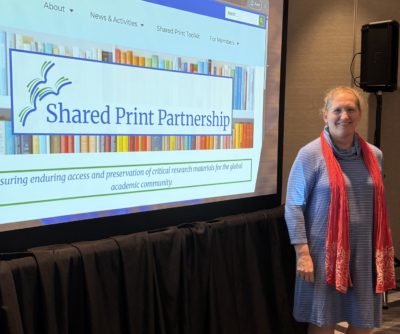
This is the first in a series of SPP Spotlight interviews with individuals working in the SPP shared print community. For our first interview Miranda Bennett, Director of Shared Collections at the California Digital Library and recent chair of the SPP Executive Committee from July 2025-June 2026, answers questions about her first interest in shared print as “a space where libraries could exercise a lot of agency,” and her thoughts about the promising future of the SPP and the shared print community.
How did you first become interested in shared print?
I remember hearing about shared print at CRL member meetings when I was at University of Houston, where I served as Head of Liaison Services for Collections and Research Support. I appreciated how shared print offered libraries an opportunity to work collectively to address several needs – repurposing space, preserving collections, and ensuring access to print today and into the future. It was exciting to be in a space where libraries could exercise a lot of agency, since we generally have more decision-making authority over our print collections than over our licensed electronic content. I learned more about shared print when University of Houston became a HathiTrust Shared Print Program retention library and later when I became Associate Dean for Collections at University of South Carolina, which participated in Scholars Trust through ASERL.
I appreciated how shared print offered libraries an opportunity to work collectively
What is your current job and how does it relate to shared print?
As Director of Shared Collections at California Digital Library (University of California), I’m responsible for a program area that includes our Shared Print team (Alison Wohlers and Nika Burns Teshin), who do amazing work for UC Shared Print and WEST. CDL is the administrative host for WEST, so I get to serve as the admin host representative on the WEST Executive Committee. UC and WEST represent enormous print collections, and it’s an honor (though at times a bit daunting) to work with Alison, Nika, our UC campus library colleagues, and WEST member leaders to steward these valuable resources in responsible ways that bring broad, long-term benefit.
You’ve just finished your term as Executive Committee Chair for the SPP from July 2025-June 2026. What has the SPP achieved in the last year that you are you most proud of?
I was really pleased to participate in SPP leadership as EC Chair, especially since all the committee members were so thoughtful and engaged. I admit we spent more time than I had anticipated focused on internal governance, building on the excellent foundation provided by the Bridge Year Executive Committee, but I think this was important and necessary. When I reflect on the work we did to develop and approve well-founded bylaws, elect a strong Operations Committee, recruit and onboard an excellent Program Coordinator, and establish a solid annual budgeting process, I see how it will enable SPP to move confidently into more outwork-facing activities in 2026-27 and beyond.
The SPP is just getting started as a new organization. What are you most excited to see the SPP doing in the near future?
Having seen the shared print community’s enthusiastic response to the first round of updates to the SPP website, I’m excited to see this become a more effective resource for shared print practitioners and a venue for promoting the value of shared print. I also think SPP has the opportunity to provide coordinating support across shared print programs and initiatives at a time when many libraries are under serious budgetary and other pressures that may change their perspective on shared print.
Shared print…is central to enabling libraries to advance their values and priorities
What do you think the most important long term goal(s) are for shared print?
I think it will always be important for those engaged with shared print to accommodate related goals that are sometimes in tension, such as the need to both provide access to materials today and preserve them for tomorrow, and balance the tradeoffs between collective commitments and local autonomy. Skillfully navigating these tensions will be important to ensure shared print programs and initiatives provide value to the library and scholarly community.
What would you most like the library community to know about shared print and the SPP?
Shared print is not a marginal or nice-to-have part of library work; it is central to enabling libraries to advance their values and priorities, including long-term preservation of the scholarly record, responsible and responsive use of physical space, mitigation of risk to collections, creative approaches to connecting users to content, and reduction of environmental impact.
What is your favorite part of library work?
I really appreciate the opportunity to work within academia because I love ideas and questions and the pursuit of new knowledge, and, within academia, I’m grateful to have ended up in libraries, because that’s where all those heady things meet practical realities like budgets, physical spaces, contract terms, and, yes, legacy print collections. The work is often hard, but it’s never boring, and I’m always in great company with wonderful colleagues.
What is currently your favorite thing outside of library work?
My husband and I have three teenage sons, and they’re the best. I love seeing them grow into their own interesting, funny, unique individuals.
Are you an SPP member who would be interested in doing and SPP spotlight? Or would you like to nominate someone? If so, send an email to info@sharedprint.org